“When are you going to do it up, then?”
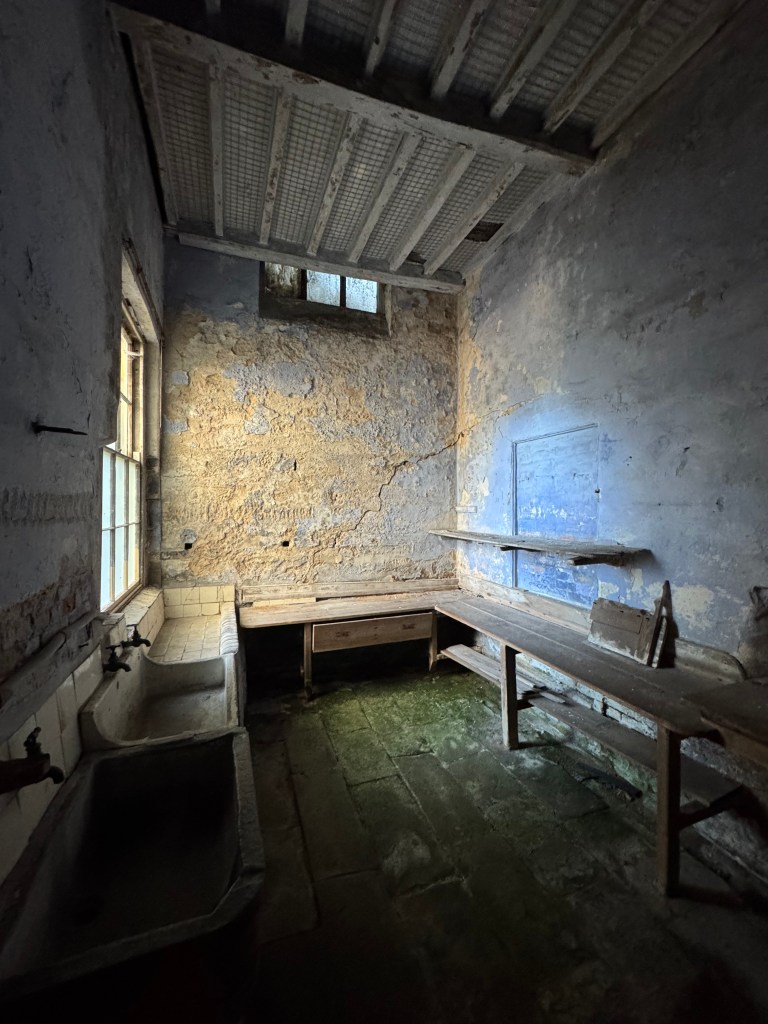
National Trust volunteer Karen says this is the most surprising reaction people have when they visit Calke Abbey, the ‘un-stately’ stately home in Derbyshire that has been left in a rundown condition for the past 40 years. We’re standing in the grand kitchen, once staffed by 27 servants but now littered with rusted cooking equipment and broken chairs, its yellow-painted plaster cracked and faded. Karen and fellow volunteer Sue have just given an excellent guided history of the service women who contributed to the running of the house and a tour of the spaces they worked in (non-members £5, booking essential).
To ask the question is to miss the point of Calke entirely. The house may look Baroque and stately on the outside, but it’s dank and dim inside. Curls of decades-old paint peel away from high ceilings and cornices. Staircases creak and shudder. In the school room, where once a governess taught languages and devised plays for the Harpur-Crewe family’s five children to perform, sheets of mouldering wallpaper sag from the walls. A box in the day nursery is labelled ‘Nanny’s teeth’ but is thankfully empty.
Disrepair is on display for a reason, with Calke standing as a monument to the slow march towards decline that many country houses experienced during the 20th century, and which so few survived. The 19th century Harpur-Crewes were hoarders, cramming the house full of toys, textiles, paintings, furniture and a natural history collection comprising taxidermy animals, insects and birds on a scale that is rare for a historic house. Death duties bit into the family’s wealth over its last couple of generations, and to save money, building repairs were scaled back and staffing levels cut. Rooms were closed off, their contents sold or shunted into the more habitable areas. The house and its occupants largely withdrew from public attention.
Unable to pay an £8 million death duty bill following his brother Charles’s death in 1981, there was nothing for it but for Henry Harpur-Crewe, a childless bachelor and the last of the 12 generations that had inhabited the house since the 1620s, to broker a deal with the National Trust to take over the estate. Yet rather than restore the house and its contents to their past glories, the Trust decided instead to embark on a programme of preserving the house in the state in which it was found when it was handed over in 1985.
Partly this is because they didn’t know which point in history to go back to, Karen explains, and mainly because the history of so many houses that went through such decline has been lost forever. As Sue puts it, Calke is “a Georgian house with a Victorian interior and a 20th century story.” The layers of history and stories within enticed Karen to the estate as a volunteer ten years ago, and underline just why this uniquely dishevelled house is preserved in its decline today.


 Postcards From Dan